
concepts

Experience the stunning spring bloom in a Paris park, featuring vibrant flowers and lush greenery.

Operators

Table of Contents Variables store values. But what do you actually do with those values? You add them, compare them, combine them, check them. That’s where operators come in. An operator is a symbol that tells Python to perform a specific operation between values or variables. You’ve been using one already — the = sign

Operators Read More »

Stunning aerial view capturing the vibrant blue ocean waters of Central Kalimantan, Indonesia.

Strings

Table of Contents We’ve already met strings briefly — they showed up when we printed ‘Hello, World!’ and when we stored names in variables. But strings are so commonly used in Python that they genuinely deserve their own post. Almost every real-world program works with text in some form — usernames, messages, file names, URLs.

Strings Read More »

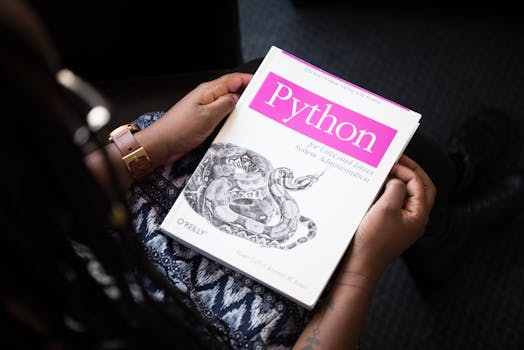
A person reads 'Python for Unix and Linux System Administration' indoors.

Python Syntax — Indentation, Whitespace, Case Sensitivity & Keywords

Table of Contents Every language has rules. English has grammar. Maths has order of operations. And Python has syntax. Syntax is simply the set of rules that define how you write code that Python can actually understand. Break the rules, and Python throws an error. Follow them, and everything runs smoothly.   The good news?  Python’s

Python Syntax — Indentation, Whitespace, Case Sensitivity & Keywords Read More »